 Tuoro sul Trasimeno
 Montefeltro
 Francigena Film Festival
 Guided tour and tasting
 Stress-free Elba: practical tips for planning the perfect holiday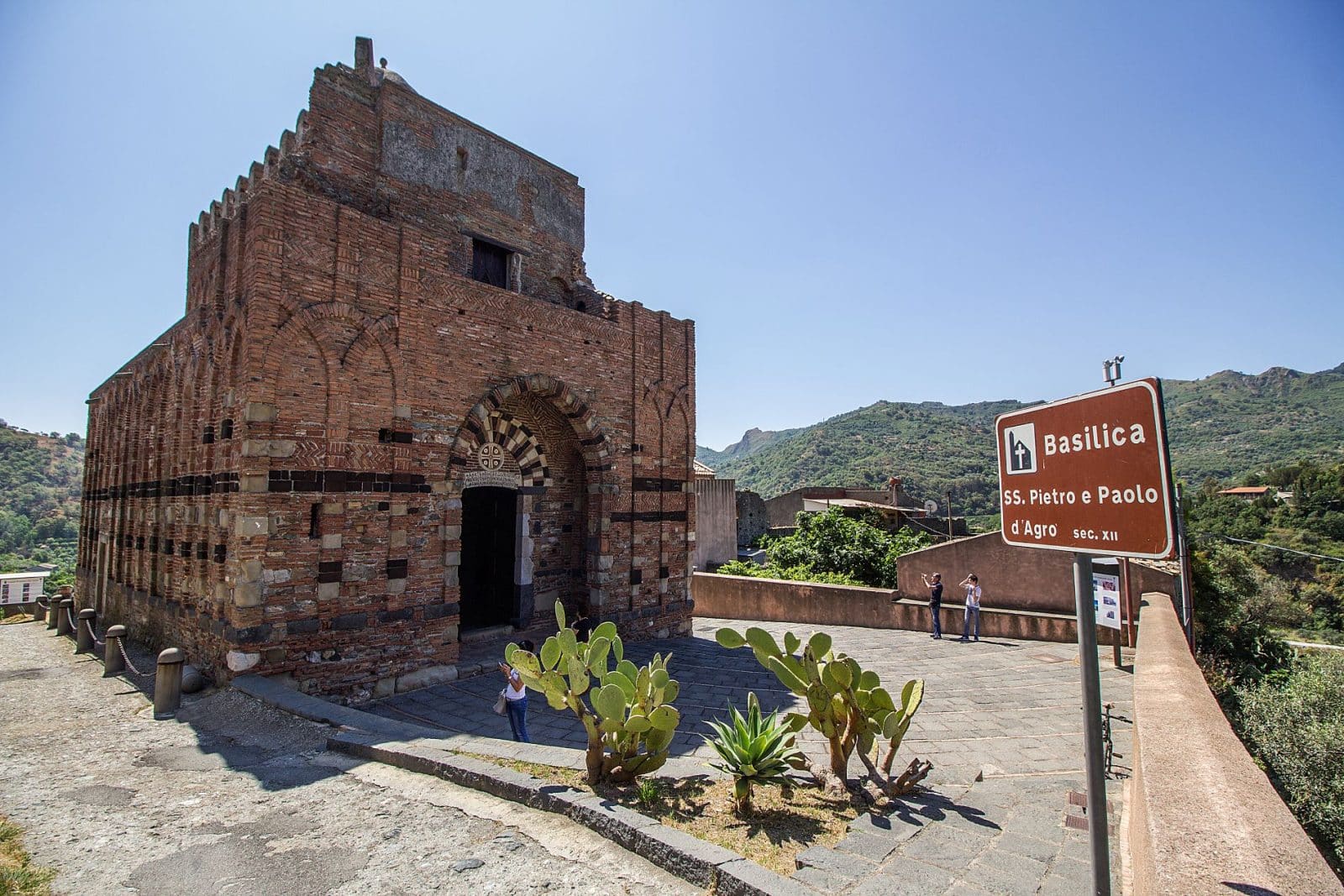
On a small promontory overlooking the left bank of the Agrò stream, in the territory of Casalvecchio Siculo, stands the Church of Saints Peter and Paul of Agrò, one of the most extraordinary medieval monuments in eastern Sicily. It is a building that is unrivalled in terms of historical and architectural value, capable of harmoniously blending different cultures – Byzantine, Arab and Norman – into a unique language.
The Norman origins and the Basilian monastery
The history of the abbey is set against the backdrop of 12th-century Norman Sicily. After taking the island from the Arabs, the Normans established a privileged relationship with the Basilian monks, encouraging their return and presence in the reconquered territories. In 1116, Roger II of Altavilla granted the Basilian monk Fra Gerasimo land and privileges, authorising him to rebuild the ancient monastery dedicated to Saints Peter and Paul, which had existed in previous times and been destroyed during Arab rule.
Work began in 1117. The building was affected by the devastating earthquake of 4 February 1169, before being consecrated in 1178. The monastery remained active until 1794, when the monks moved to Messina. An autonomous economic and social system developed around it, supported by royal concessions that guaranteed land, grazing rights, tithes and tax privileges.
Architecture without comparison
The Church of Saints Peter and Paul in Agrò is unique in Mediterranean religious architecture. The structure combines a central layout, typical of the Byzantine tradition, with a Latin basilica layout. The result is an articulated and symbolically powerful construction: a central dome, over 17 metres high, which recalls the Basilian conception of God at the centre of everything, and a second dome above the transept, expressing the Latin vision of God as the ultimate goal.
The exterior is striking for its extraordinary polychromy, achieved by alternating local materials: bricks, sandstone, limestone and lava stone create a vibrant pictorial effect. The façade is characterised by an exonarthex framed by two stair towers; the main portal has an arch composed of different types of stone blocks and, in the lunette, a Greek cross inscribed in a disc. Islamic decorative elements, Nordic verticalism and Byzantine pictorialism coexist in a refined synthesis that makes the building unique.
The domes and symbolism
Originally, the church had four domes: two on the façade, which have now disappeared, a large one in the centre of the nave and one on the transept. The current domes, connected to the structure by small arches of clear Arab influence, give the whole building a vertical thrust that combines the idea of a tower with that of a place of worship.
The interior housed the relics of numerous saints, including Saints Peter and Paul, Saint Blaise, Saint Nicholas, Saint Lucy and other martyrs, reinforcing the spiritual prestige of the monastic complex in the Valle d’Agrò area.
A spiritual and cultural centre
The abbey was not only a place of worship, but also an important economic and administrative centre. The privileges granted by the Norman sovereign guaranteed the monastery control over villages, lands, agricultural activities and even fishing and navigation rights. This system consolidated the abbey’s role as a religious and social reference point for the entire area.
Today, next to the church, an immersive museum guides visitors through videos and multimedia content that recount monastic life, the history of the building and the cultural context in which it was built.
A masterpiece of medieval Sicily
The Church of Saints Peter and Paul in Agrò is considered one of the finest examples of medieval Sicilian art. Its strength lies in its ability to blend different worlds in an extraordinary architectural balance, a concrete symbol of the coexistence of cultures that has marked the history of the island. Immersed in the silence of the Agrò Valley, it continues to tell the story of the deep soul of Norman Sicily with its polychrome stones and domes.