 San Martino di Castrozza
 VIVA! Festival 2026
 Tandem paragliding flights in Tirolo and Merano: the thrill of flying over the Alps
 Recipe: Polta di Pacentro, the peasant dish that symbolises the traditions of Abruzzo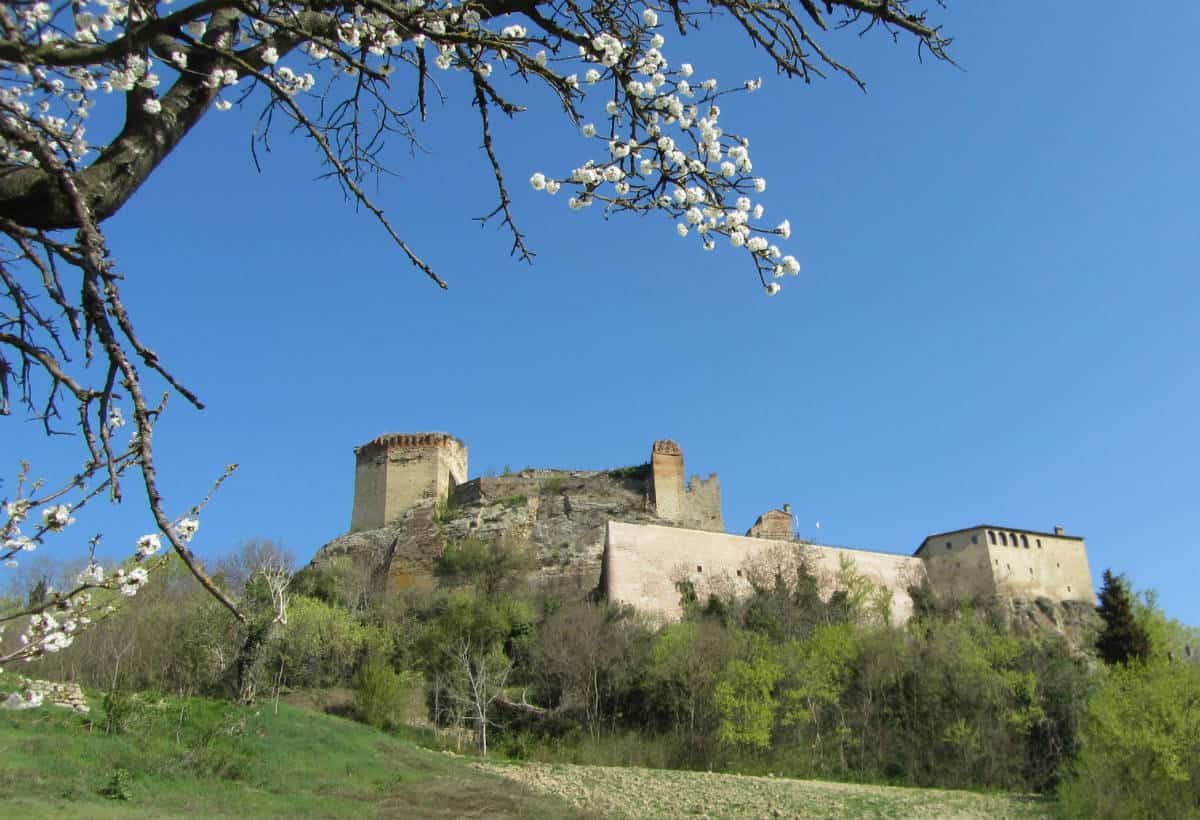
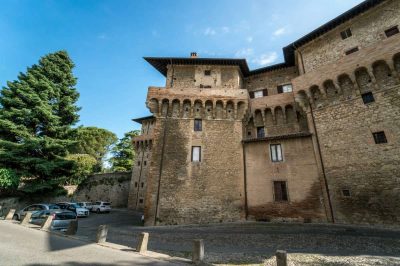
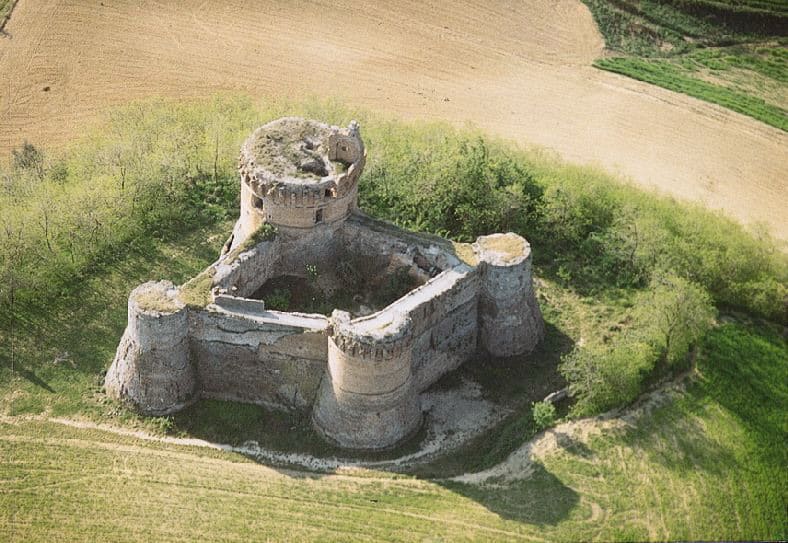
The Medieval Fortress of Castrocaro has dominated the Montone valley for over a thousand years, rising majestically from the distinctive Spungone cliff that overlooks the villages of Castrocaro Terme and Terra del Sole. Regarded as one of the most extraordinary examples of Italian medieval fortified architecture, the fortress represents a perfect fusion of natural landscape, military engineering and history.
First mentioned in 961 as Castrum Aukario, the fortress played a fundamental strategic role in controlling the territories between Romagna and Tuscany, becoming over the centuries one of the main strongholds of Florentine Romagna. The entire complex is organised into three distinct defensive sections: the Girone, the Rocca and the spectacular Medici Arsenals.
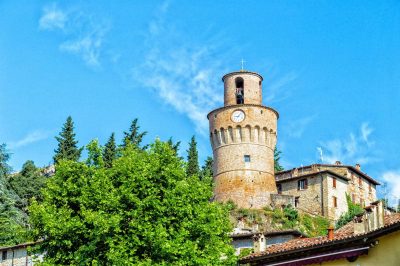
Entry to the fortress is via the imposing Torre Guelfa, also known as the Torre delle Segrete, which stands 37 metres tall and is connected internally by a spectacular spiral staircase of 102 steps. From the top, one of the most evocative views of Romagna unfolds: the vista stretches from the castle of Monte Poggiolo all the way to Ravenna and the Adriatic Sea.
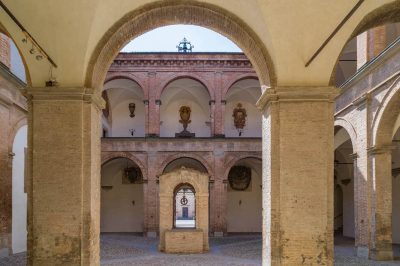
Once you have crossed the drawbridge, you enter the Cortile del Soccorso, dominated by the Palazzo del Castellano, the former residence of the feudal lords of Castrocaro, which today houses the MuSA, the Historical and Archaeological Museum of the Castle and the Town. The exhibition rooms contain weapons, majolica, furnishings, documents and artefacts that recount the medieval and Renaissance history of the fortress and the surrounding area.
Among the most fascinating areas are the Medici Arsenals, built in the 16th century under the direction of Antonio da Sangallo the Elder and Giovan Battista Belluzzi, known as ‘Il Sammarino’. Vast vaulted chambers, partly carved out of the spungone rock, create settings of great architectural and military significance. Here lie ancient casemates, secret corridors and underground chambers still shrouded in mystery today.
The fortress’s inner courtyard houses a rare medieval cistern for collecting and filtering rainwater, as well as evocative troglodytic caves used since Neolithic times and later adapted into an oven, cellar and storerooms. Not far away stands an exceptional 17th-century olive tree with a now-extinct genome.
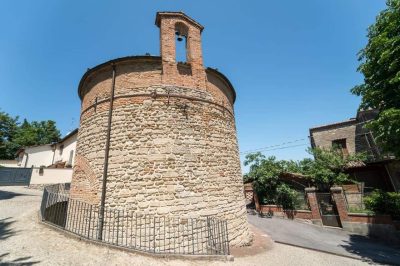
In the heart of the courtyard also stands the picturesque Church of Santa Barbara, a small temple set into the rock that houses sacred paintings, historic furnishings and a precious 16th-century wooden Christ.
The oldest part of the fortress is the Girone, dating back to the 9th century. Here stands the imposing 32-metre-high pentagonal keep, built from regular blocks of spungone stone. From its summit, the view overlooks the entire Forlì plain and the surrounding hills.
The Fortress of Castrocaro Terme and Terra del Sole is also a place of legends and folk tales: among the most famous is that of Margherita de’ Conti, a young woman in love who, according to tradition, threw herself from the castle’s highest tower on the eve of her wedding.
Today, the complex is one of the most important cultural centres in Romagna, hosting museums, historical events, performances and immersive experiences that allow visitors to embark on an authentic journey through the Middle Ages and the Renaissance.