 San Martino di Castrozza
 VIVA! Festival 2026
 Tandem paragliding flights in Tirolo and Merano: the thrill of flying over the Alps
 Recipe: Polta di Pacentro, the peasant dish that symbolises the traditions of Abruzzo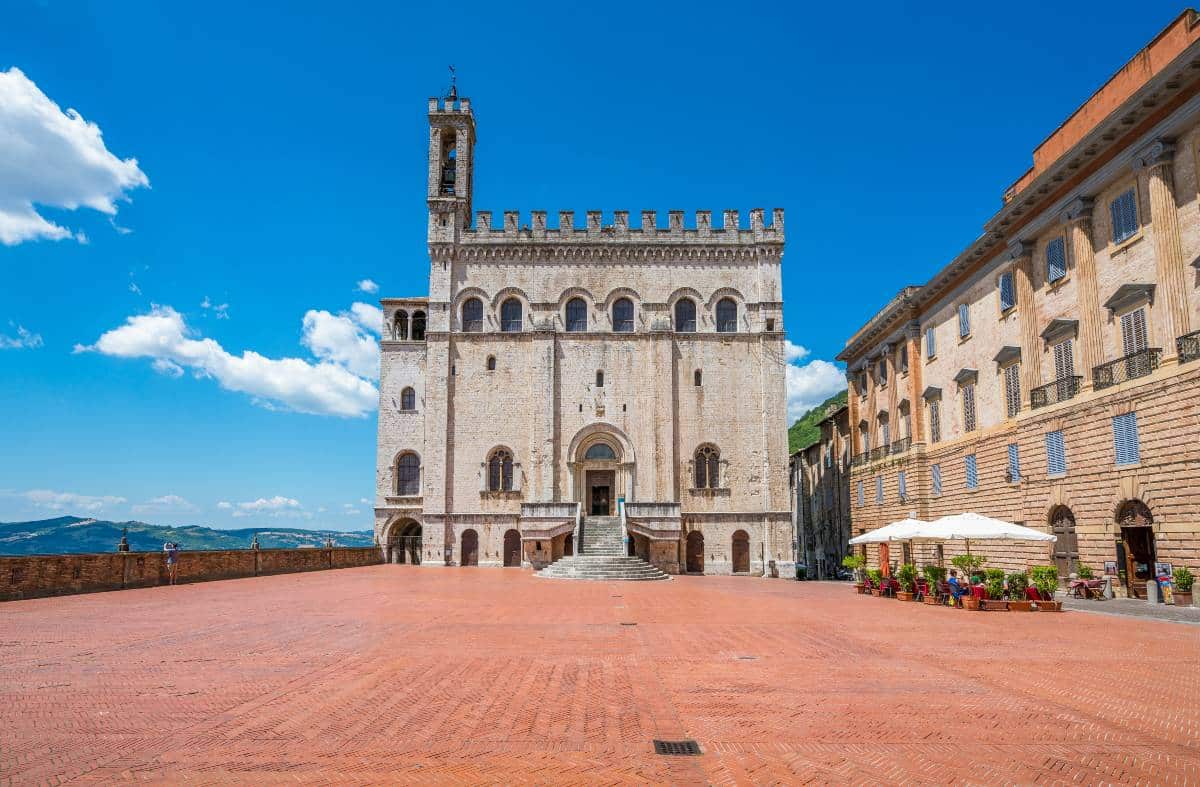
The Palazzo dei Consoli dominates the historic centre of Gubbio, overlooking the spectacular Piazza Grande, the famous hanging terrace that represents the political and symbolic heart of the medieval city. Together with the Palazzo del Podestà, it constitutes one of the most daring and grandiose urban achievements of 14th-century Italy, a concrete expression of the strength and pride of the Free Commune of Gubbio.
The symbol of the Free Commune
The construction of the monumental complex was decreed between 1321 and 1322, during a period of strong economic and institutional expansion in the city. By the mid-14th century, the main structures were almost complete. The project, attributed to Angelo da Orvieto, with the contribution of Matteo di Giovannello, known as Gattapone, responded to the need to provide Gubbio with a new political centre commensurate with its prestige.
The palace was conceived as the seat of the main municipal magistrates: it was here that the General Council of the People, the Consuls, the Gonfaloniere di Giustizia, the Capitano del Popolo and the Connestabile with his armed guards met. It was therefore the hub of the city’s public, administrative and judicial life.
The building is also surprising for the technical solutions adopted: it was equipped with an internal aqueduct capable of supplying fountains, toilets and running water pipes, a sign of the high level achieved by Gubbio’s craftsmen in the 14th century.
Gothic architecture and monumental grandeur
With its rectangular layout, the Palazzo dei Consoli stands out for its marked vertical thrust, emphasised by pilasters that divide the façade into three parts. The large Gothic portal, reached via a spectacular fan-shaped staircase, is surmounted by a lunette frescoed in 1495 by Bernardino di Nanni dell’Eugenia depicting the Madonna and Child between St John the Baptist and St Ubaldo, later remodelled by Benedetto Nucci.
The second order is marked by six elegant arched windows, while the crenellated crown with ogival arches gives the building a solemn and fortified appearance. On the left side stands the bell tower, a distinctive feature of the Gubbio skyline, visible even from a distance.
The entire complex blends harmoniously into Piazza Grande, designed as a neutral public space, equidistant from the city’s neighbourhoods, a symbol of balance and political impartiality.
The Arengo Hall and the interior rooms
On the first floor is the majestic Sala dell’Arengo, a vast room covered by imposing barrel vaults, used for city assemblies. Here, you can still feel the evocative power of medieval municipal authority.
Since 1909, the building has housed the Civic Museum, spread over several floors. The ground floor houses the archaeological collection, which tells the story of the area from prehistory to the Roman era; the upper floors house the art gallery, with works illustrating the local artistic evolution up to the 20th century.
A medieval urban masterpiece
The Palazzo dei Consoli was built at a time of great political ambition, when Gubbio felt the need to abandon the ancient Platea Communis in the upper part of the city to create a new, larger and more representative administrative centre. The construction of the hanging square and the palace marked a decisive transition in the urban and institutional history of Gubbio.
Even today, visiting the Palazzo dei Consoli means entering the heart of medieval Gubbio: a place where architecture, power and civic identity merge into a whole of extraordinary scenic and historical power.