 San Martino di Castrozza
 Malvasia in Porto 2026
 Tandem paragliding flights in Tirolo and Merano: the thrill of flying over the Alps
 Recipe: Polta di Pacentro, the peasant dish that symbolises the traditions of Abruzzo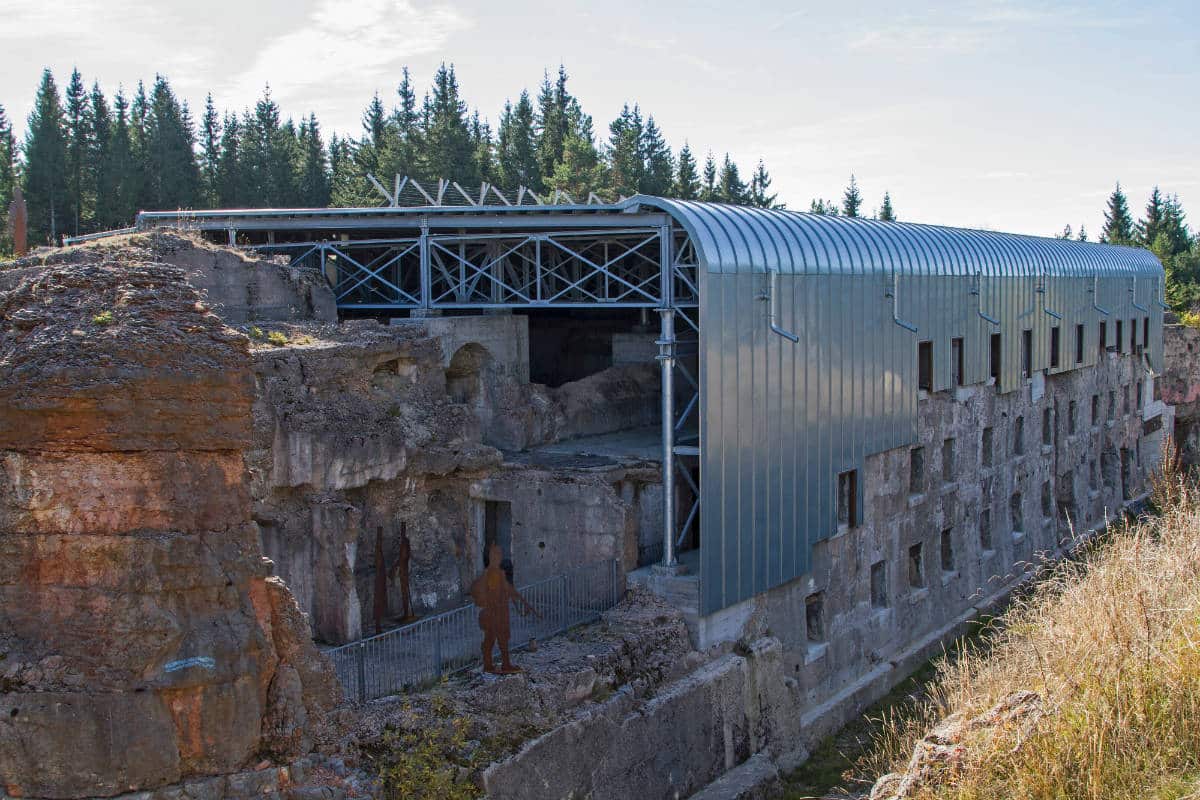
Forte Campo, also known as Forte Luserna, is one of the most imposing Austro-Hungarian fortifications from the First World War and overlooks the Cima Campo hill at an altitude of 1,549 metres, in the Luserna area. Situated in a strategic position between the Val d’Astico and the Val Torra, the fort was one of the defensive cornerstones of the fortified system built by the Austro-Hungarian Empire on the Trentino highlands.
The fortress was built between 1908 and 1912 to control the Passo Vezzena sector and prevent any Italian breakthroughs along the southern border of Tyrol. Due to its imposing size and extraordinary firepower, Italian soldiers nicknamed it ‘Il Padreterno’.
The complex consisted of a huge main structure partially carved into the rock, flanked by the armoured outposts of Viaz and Oberwiesen, linked by long underground tunnels and protected walkways. The structure, built of reinforced concrete with blast-resistant coverings over three metres thick, was considered one of the most advanced examples of military engineering of the time.
The fort had a garrison of over two hundred men, officers’ quarters, an independent power station, water and fuel depots, and sophisticated communication systems linking it to other Austro-Hungarian fortifications on the high ground, including Fort Verle and Fort Belvedere-Gschwent.
The fortifications included four 10 cm howitzers housed in armoured turrets, rapid-fire guns and no fewer than nineteen machine-gun posts distributed between the main body of the fort and the outposts. To defend the fortress against infantry assaults, deep moats and extensive barbed-wire entrenchments were also constructed.
Forte Luserna was at the centre of one of the most dramatic episodes of the war on the highlands. In the early days of the conflict, between 25 and 28 May 1915, it came under a ferocious Italian bombardment involving over 5,000 shells. Artillery from Forte Verena, Campolongo and other Italian positions succeeded in destroying part of the armoured towers and putting the garrison in serious difficulty.
Exhausted by the continuous bombardment, the smoke and the inability to communicate with the outside world, Commander Emanuel Nebesar temporarily ordered the white flag to be raised. Surrender was, however, averted thanks to the intervention of nearby Austro-Hungarian fortresses, which opened fire to halt the Italian advance, whilst some soldiers managed to reach the fort and remove the white flag.
Despite the severe damage, the fortress was quickly restored to working order and continued to fight in the months that followed. During the war, the fort was struck by thousands of large-calibre shells, becoming one of the symbols of Austro-Hungarian resistance on the highlands.
After the war, the structure passed into the hands of the Italian State and, in the 1930s, underwent extensive demolition to recover metals for the steel industry. Many parts of the fortress were blown up with dynamite, causing irreparable damage.
In recent decades, thanks to the efforts of the Municipality of Luserna and the Autonomous Province of Trento, the fort has been progressively restored and enhanced. Today, visitors can explore trenches, underground tunnels, outposts and numerous interior spaces, which offer an insight into the extraordinary complexity of this military structure.
Forte Campo remains one of the most striking reminders of the Great War in the mountains of Trentino, a place where history, memory and the Alpine landscape merge to create a deeply evocative atmosphere.