 San Martino di Castrozza
 VIVA! Festival 2026
 Tandem paragliding flights in Tirolo and Merano: the thrill of flying over the Alps
 Recipe: Polta di Pacentro, the peasant dish that symbolises the traditions of Abruzzo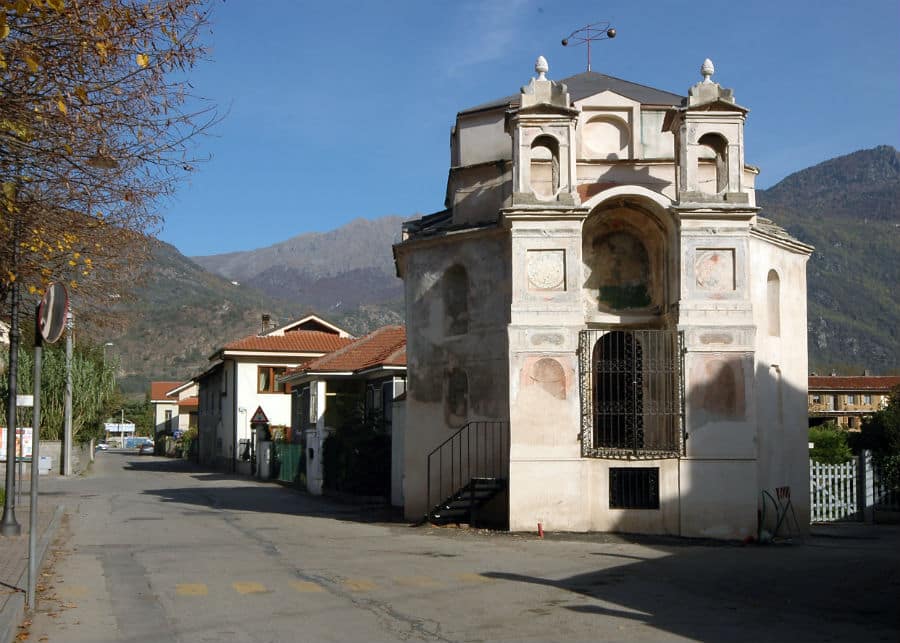
The Chapel of St Joseph in Chiusa di San Michele is one of the most distinctive and mysterious monuments in the Susa Valley, a place where archaeology, medieval history and architecture intertwine in a surprising way. Today, the building houses an impressive planetarium, but its origins tell a much older and more fascinating story.
The current chapel features a unique central plan characterised by four curved recesses at the corners and a striking external staircase on the south side. The appearance visible today is the result of the last major restoration carried out in the early 19th century, when the Cantore family transformed the ancient building into a chapel dedicated to St Joseph. The interior decoration, featuring yellow plasterwork and faux marble plinths, the current roof and the painting on the façade depicting the Virgin and Child with St Joseph all date from this period.
However, recent archaeological investigations have revealed that a much older building lies hidden within the chapel, incorporated into the later structures. The foundations visible at the base reveal a building of unusual shape, consisting of four straight walls joined by curved structures that appear to belong to small circular towers. This distinctive layout, which encloses an internal space approximately six and a half metres in diameter, does not appear to be compatible with a religious function, but rather with that of a small defensive fortification.
Archaeologists hypothesise that the original complex was a fortified structure dating back to the early Middle Ages, likely linked to a defensive system in the valley. The excavation has in fact also identified a straight wall that can be interpreted as part of a fortified enclosure connected to the main building. Subsequently, between the 10th and 11th centuries, the structure was rebuilt whilst retaining the original layout with the four turrets, continuing to be used until its conversion into a religious building in the following centuries.
The chapel first appears on 18th-century Savoyard maps under the name ‘Pilone’, a sign that it had already taken on a devotional role for the local population by that time. Today, thanks to restoration and enhancement work, this site stands as a rare architectural testament that tells the story of centuries of historical transformations, from a medieval fortification to a religious chapel and on to its current cultural use.
Set within the extraordinary historical context of the Susa Valley, the Chapel of St Joseph continues to captivate visitors with its enigmatic charm, offering a unique insight into ancient defensive architecture and the history of the region.