 San Martino di Castrozza
 VIVA! Festival 2026
 Tandem paragliding flights in Tirolo and Merano: the thrill of flying over the Alps
 Recipe: Polta di Pacentro, the peasant dish that symbolises the traditions of Abruzzo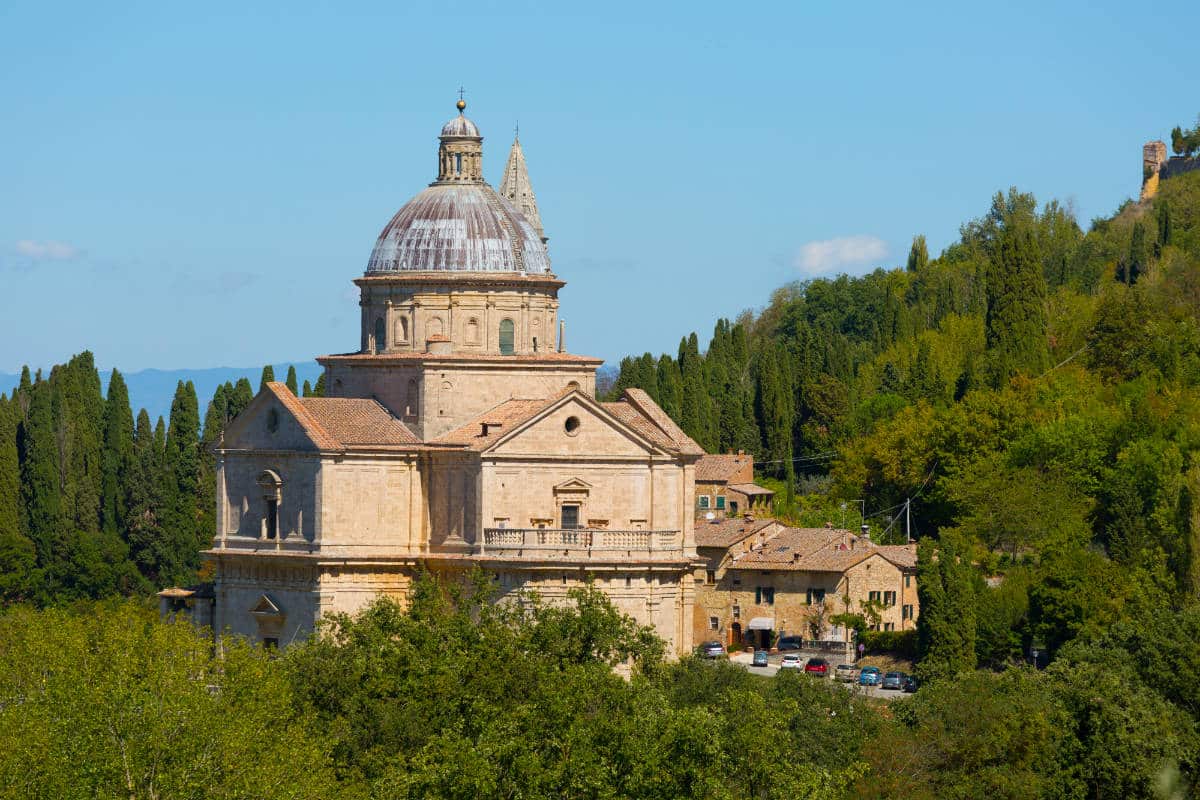
The church of San Biagio, also known as the Temple of San Biagio due to its monumental size, was designed by Antonio da Sangallo the Elder and is a magnificent example of 16th-century Tuscan Renaissance architecture. It stands just outside the historic centre of Montepulciano, in an isolated position. The Renaissance building was constructed on the site of an ancient early Christian parish church dedicated to St. Mary and later, after the transfer of parish rights around the year 1000, within the castle walls, to St. Biagio. At the beginning of the 16th century, only a few remains of the parish church were preserved; in one wall there was still a fresco depicting the Madonna and Child with St. Francis, a 14th-century Sienese work, to which miraculous events were attributed in 1518. The echo of this devotion spread far beyond the Valdichiana area: in 1519, for example, the municipality of Sansepolcro decided to contribute to the expenses of the pilgrimages that the companies and people of the city would undertake to visit the Madonna di San Biagio, to whom many communities had already sent gifts.
The main facade, whose compositional scheme is repeated with some ornamental variant, on the other two side portions, which constitute the end walls of the transept, is divided in two registers by a marked entablature from frieze with triglifi and metopes that runs around the whole perimeter of the temple: in the lower one is placed the portal on which is engraved the year of the foundation of the temple; the upper one, with at the center a window, the surface is moved by five rectangular mirrors. The second register is set large triangular pediment in whose center is located an oculus circular. The main prospect is flanked on the left side from the towering bell-tower in more registers, dense plastic elements-decorative, ending in a pyramid-shaped spire; peculiar characteristic of the tower is being divided into three bands, each of which is decorated with semi-columns and pillars of different architectural orders: from below, tuscanici, Ionic and Corinthians.
The church of San Biagio has a Greek cross plan, with four rectangular arms symmetrical encountered in square cruise, covered by a dome, 13 meters in diameter, which was built between 1536 and 1544. The latter has a circular cross section and rests on the four spandrels. There is a great difference between the outer drum (moved by Ionic pilasters that alternate with niches and windows) and the internal one (with a mock loggiato formed by a series of high round arches), being the latter at a lower height than the first. The cover is composed of a double cap with at the center a narrow gap and ends at the top with the lantern, also with Windows.
Each of the four arms of the church is covered with a barrel vault in cassettonata part and lit by a rectangular window that opens in the wall of the bottom. Furthermore, in the side walls of the nave and transept, open niches round arched, inside of which there are of the lateral altars marble.
Close to the wall the seabed of the apse (the semicircular apse visible externally constitutes the sacristy) you will find the main altar, characterized by rich dossal there in marble, work of Giannozzo and Lisandro of Peter Albertini who realized in 1584. At the center, between two Corinthian columns, there is the fourteenth-century fresco, considered miraculous, depicting the Madonna enthroned with Child, said of the Madonna di San Biagio; at the sides there are four niches, each of which contains a marble statue of Ottaviano Lazzeri; sculptures, dating back to 1617, depict (from left) Saint John the Baptist, St Catherine of Siena, St Agnes and San Giorgio.