 San Martino di Castrozza
 VIVA! Festival 2026
 Tandem paragliding flights in Tirolo and Merano: the thrill of flying over the Alps
 Recipe: Polta di Pacentro, the peasant dish that symbolises the traditions of Abruzzo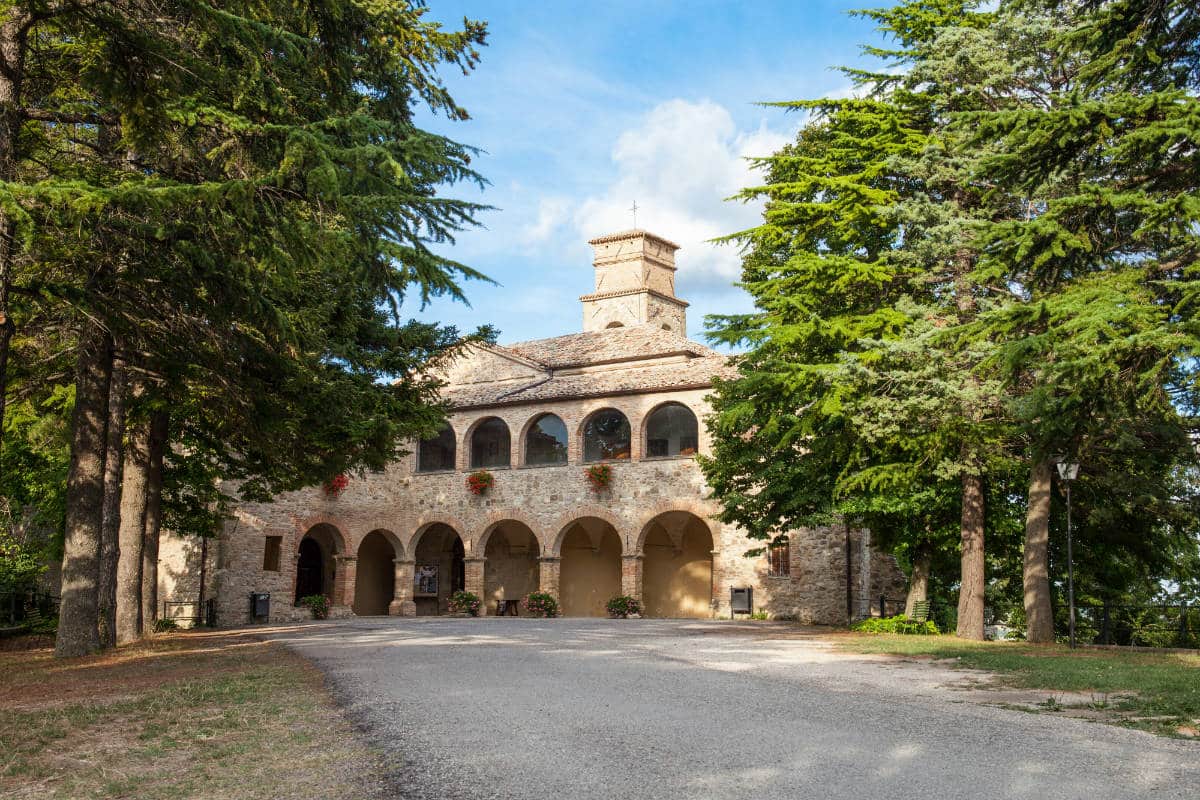
The Convent of Montefiorentino is one of the most fascinating religious complexes in the Marche region, nestled in a lush and picturesque landscape on a hill overlooking the town of Frontino. Tradition attributes its foundation to St Francis of Assisi in 1213, whilst a papal bull of 1248 granted indulgences to the faithful who contributed to its restoration, testifying to the importance of the site as early as the medieval period.
Over the centuries, the convent has undergone extensions and alterations, particularly in the 17th century, yet it has retained an imposing structure that still makes it one of the largest convent complexes in the region. The entire complex covers over ten hectares, comprising interior spaces, green areas and spaces dedicated to communal life.
The artistic heart of the complex is the Chapel of the Counts of Oliva, built in 1484 at the behest of Count Carlo Oliva and attributed to Francesco di Simone Ferrucci. This refined yet uncluttered space is an extraordinary example of Renaissance architecture, characterised by pure and harmonious lines. The finely carved marble sarcophagi, together with the inlaid kneelers created by Maestro Zocchino in 1493, evoke the elegance of the Duke of Urbino’s studiolo and bear witness to an exceptionally high artistic standard.
The church also houses one of the most significant works of the Marche Renaissance: the altarpiece by Giovanni Santi, father of Raffaello Sanzio, depicting the Madonna and Child with Saints George, Francis, Anthony the Abbot and Jerome, dated 1489. The artistic heritage is completed by a fresco of Saint Anthony the Abbot attributed to Evangelista da Piandimeleto, an antique organ, a 17th-century walnut choir screen and numerous minor paintings.
The ground floor of the convent houses the cloister, around which rooms covered by round and cross vaults unfold, creating a harmonious and intimate space, typical of monastic life. The complex also houses a collection of paintings and ancient liturgical texts, including printed graduals and antiphonaries, which further enrich the cultural value of the site.
Originally, the convent also housed the famous Polyptych by Alvise Vivarini (1475), now preserved at the National Gallery of the Marche, bearing witness to the central role that Montefiorentino played in the artistic history of the region.
Today, the Convent of Montefiorentino is an unmissable destination for anyone visiting Frontino, a place where art, spirituality and nature coexist in perfect harmony, recounting centuries of history and culture in the heart of the Marche region.