 Passignano sul Trasimeno
 Montefeltro
 Borgio Verezzi Theatre Festival
 Tandem paragliding flights in Tirolo and Merano: the thrill of flying over the Alps
 Upper Val di Non: A melting pot of cultures between South Tyrol and Trentino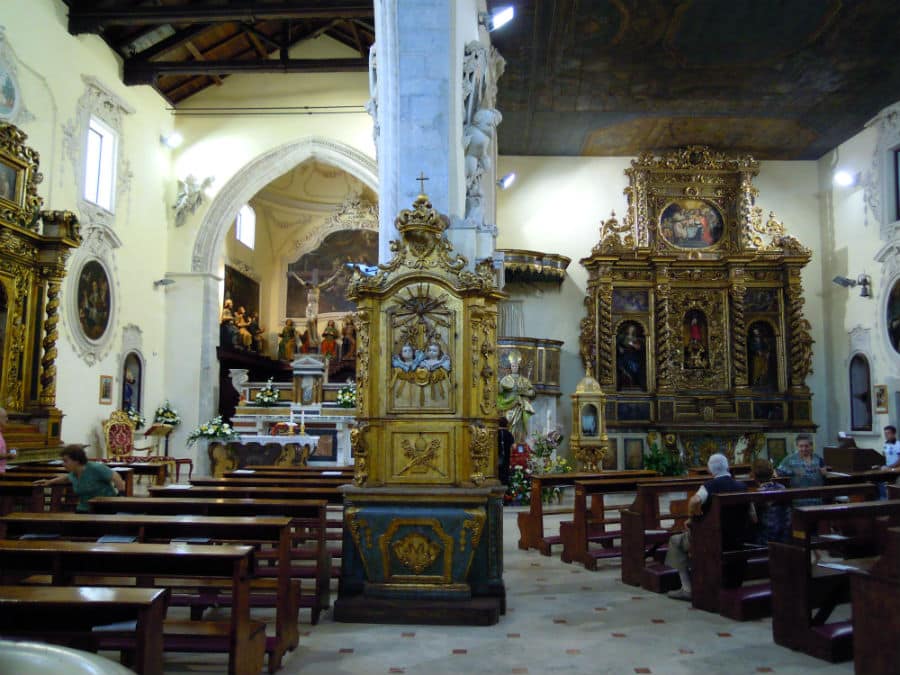
The Church of Sant’Emidio is undoubtedly the place of worship with the richest collection of important works among the many in Agnone. The building in question, which currently has two naves, was constructed outside the walls of the medieval town, almost certainly following the disastrous earthquake of 1096, and was immediately dedicated to St Emidio, the patron saint who had protected the community from the earthquake’s damage. Its original structure was that of a modest parish church corresponding solely to the present-day left aisle, aligned with the original portal, which no longer exists.
A jewel of Apulian Romanesque-Gothic art, the present façade is characterised by a rose window – with spokes originally made of stone – and a portal dating back to the early decades of the 14th century. This splendid work, commissioned by Guglielmo di Sabrano, lord of Agnone, bears strong similarities to the portals of Santa Maria Maggiore in Lanciano (1317) and the cathedral of San Pardo in Larino (1319), both created by the Lancianese master Francesco Petrini or his school. The church was renovated in 1443 by wealthy wool merchants from Ascoli in the Marca region, devotees of St Emidio, who had settled in Agnone.
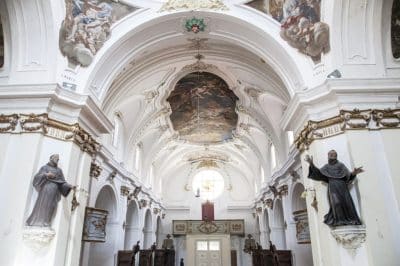
The interior, with its two asymmetrical naves, retains its 14th-century layout on the left, featuring an apse, a choir and a trussed ceiling (dating from 1443), whilst on the right, extensions from later periods are evident. Notable works of art include: the altars of St Placidus and St Emidius (first from the left in the photo), splendid examples of local woodcarving from the early 18th century.
The high altar is in polychrome marble (late 17th century), the choir in walnut made by the Agnone-based cabinetmaker Nicodemo De Simone, surmounted by 13 wooden statues depicting Jesus and the Apostles at the Last Supper (photo) (Neapolitan school, mid-17th century?). In fact, this latter work is virtually unique in its kind (there is only one other, with the same characteristics, in northern Italy).
The altar of the Holy Family undoubtedly stands out for its majesty and fine craftsmanship: situated at the front of the right aisle, it is a remarkable work in the purest Rococo style, crafted in painted wood by the Agnone-based woodcarver Giuseppe Leonelli between 1710 and 1715.
What truly brings prestige and renown to this church, however, are the works by the great Tuscan sculptors Giovanni and Amalia Duprè, who lived between the 19th and early 20th centuries: the sculptures of the Risen Christ and the Pietà group (both by Amalia) exude an intimacy that is at once genuine and deeply human; the sculptural ensemble of the baptismal font (created by the two sculptors, father and daughter, in collaboration) situated in the right aisle, beneath the organ, is a perfect stylistic example of the Florentine Neoclassical school, so much in vogue in the mid-19th century.
Also worth mentioning is the statue of the Crucifix (placed in the niche next to the Pietà group), a work imbued with the most powerful realism, by the renowned sculptor Giulio Monteverde.